Mirror, Mirror: How the Humble Selfie Became a Serious Art Form
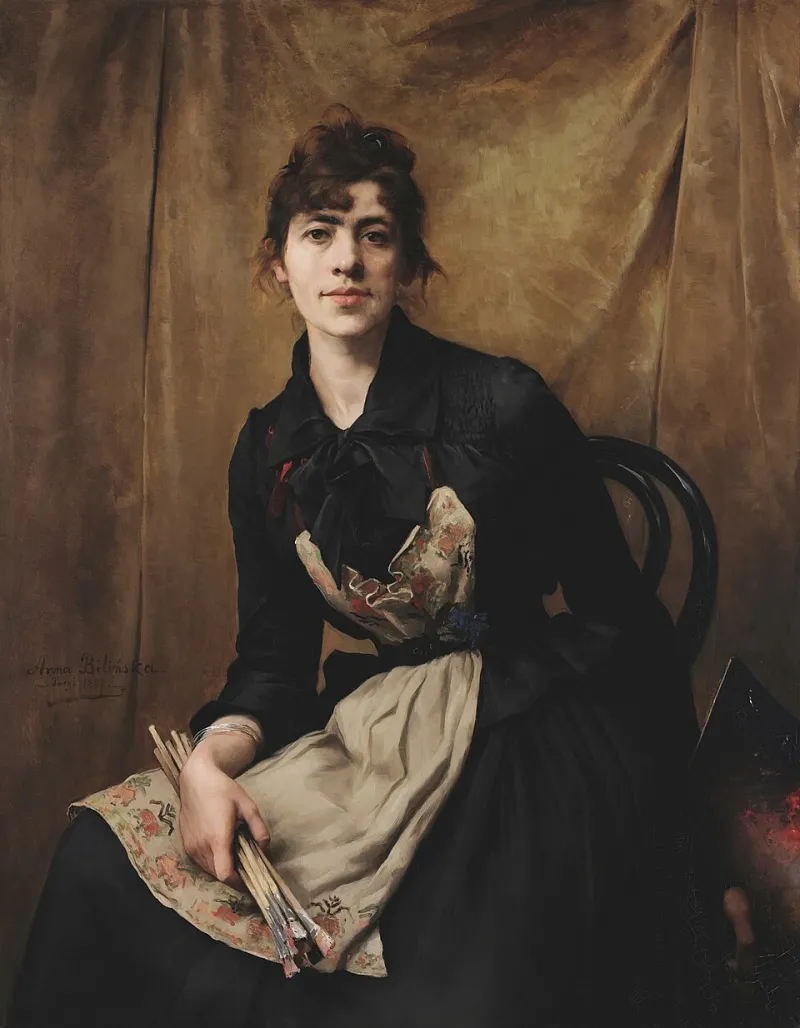
Photo: Anna Bilińska-Bohdanowicz, Public domain, via Wikimedia Commons
Let's be honest — when someone says "selfie," your brain probably jumps to duck faces, vacation poses, or that one friend who photographs every meal. Fair enough. But something interesting has been happening in galleries, MFA programs, and photography circles across the country: the selfie is getting a serious rebranding, and the art world is paying attention.
Self-portraiture as a legitimate artistic practice isn't new. Not even a little bit. But the conversation around it has shifted in ways that feel genuinely exciting for anyone who cares about visual storytelling.
From Rembrandt to Ring Lights
Rembrandt van Rijn painted himself over 80 times across his lifetime. At the time, it wasn't vanity — it was documentation, experimentation, and in many ways, a running autobiography rendered in oil and light. He used his own face as a studio tool, exploring aging, emotion, and identity in ways that portraits of wealthy patrons simply didn't allow.
Fast forward a few centuries, and you've got Cindy Sherman staging elaborate fictional personas in front of her own camera in the 1970s and '80s. Then Nan Goldin's raw, unflinching self-documentation. Then the front-facing camera on the iPhone 4 lands in 2010, and suddenly millions of people have access to what was once an exclusive artistic tool.
That accessibility is where things get really interesting.
Who Gets to Tell Their Own Story?
For most of art history, the people who controlled visual narratives — who got painted, who got photographed, who got exhibited — were a pretty narrow slice of humanity. Wealthy, white, mostly male, and almost always defined by someone else's gaze.
The democratization of photography tools, particularly the smartphone camera, blew that open. Suddenly, self-portraiture wasn't gated behind expensive equipment or studio access. A teenager in rural Mississippi could make a self-portrait as technically polished as one made in a Manhattan studio. A non-binary artist in Phoenix could document their own identity on their own terms, without waiting for someone else to see them clearly first.
Curators at institutions like the Smithsonian American Art Museum and the International Center of Photography in New York have noted a marked increase in self-portrait work entering serious exhibition consideration over the past decade. The through-line isn't the technology — it's the intentionality. The work that resonates isn't just a photo of someone's face. It's a deliberate act of visual authorship.
What Makes a Selfie Art?
This is the question that makes people squirm, and honestly, it's worth sitting with.
Photographers working in this space will tell you the distinction isn't really about gear or technique — it's about intention and context. A snapshot taken to post and forget is one thing. A self-portrait that grapples with race, gender, grief, memory, or identity is something else entirely. The camera is the same. The thinking behind the shutter is different.
Consider the work of artists like Zanele Muholi, a South African visual activist whose monumental black-and-white self-portraits have toured major US museums. Each image is a deliberate act of representation — a refusal to let someone else define what Black queerness looks like in a visual archive. That's not a selfie in the casual sense. That's a manifesto.
Closer to home, emerging American photographers are using self-portraiture to explore everything from chronic illness to immigration to the experience of aging in a culture obsessed with youth. Social platforms like Instagram have functioned as both gallery and distribution channel, letting artists build audiences without needing institutional gatekeeping.
The Authenticity Factor
One thing that comes up again and again when you talk to photographers working in this medium is the word authenticity. There's something uniquely honest about turning the camera on yourself — you can't direct the subject, you can't hide behind a third-party perspective, and you can't blame the model if the image feels false.
That vulnerability is part of what gives strong self-portrait work its emotional weight. Viewers respond to it. They recognize the exposure involved, even if they can't articulate it.
There's also a practical argument: you're always available. For photographers who are still building their practice, still learning to see, still figuring out what they want to say — having themselves as a subject means the work never has to stop. Some of the most technically innovative portrait photographers working today spent years shooting themselves simply because they were the only subject they could fully control and fully trust.
What This Means for Visual Culture
Here's the bigger picture, and why it matters beyond just the art world: when more people have access to self-representation, the visual record of human experience gets richer and more honest.
For a long time, photography's history was incomplete — not because the stories weren't there, but because the people living them didn't have the tools or the platforms to document themselves. That's changing. Rapidly.
The selfie, at its most intentional, is an act of insisting that your perspective matters. That your face, your body, your experience deserves a place in the visual archive. That's not narcissism. That's participation in a centuries-old tradition of using images to say I was here, and this is what it felt like.
For anyone who loves photography — who cares about what pictures can do and who gets to make them — that's worth celebrating.
Where to Go From Here
If you're a photographer curious about exploring self-portraiture more seriously, the good news is that the barrier to entry is genuinely low. You don't need a studio or a DSLR. What you do need is a clear sense of what you want to say — some idea of the story you're trying to tell about yourself, or through yourself.
Look at the work of photographers who've built serious practices in this space. Study how they use light, environment, and body language to communicate something beyond "here's what I look like today." Think about what makes your own perspective unique — because it is, even if it doesn't feel that way yet.
The mirror has always been one of art's most powerful tools. It turns out, so is the front-facing camera.