Grain, Grit, and Intentionality: Why a New Generation Is Shooting on Film
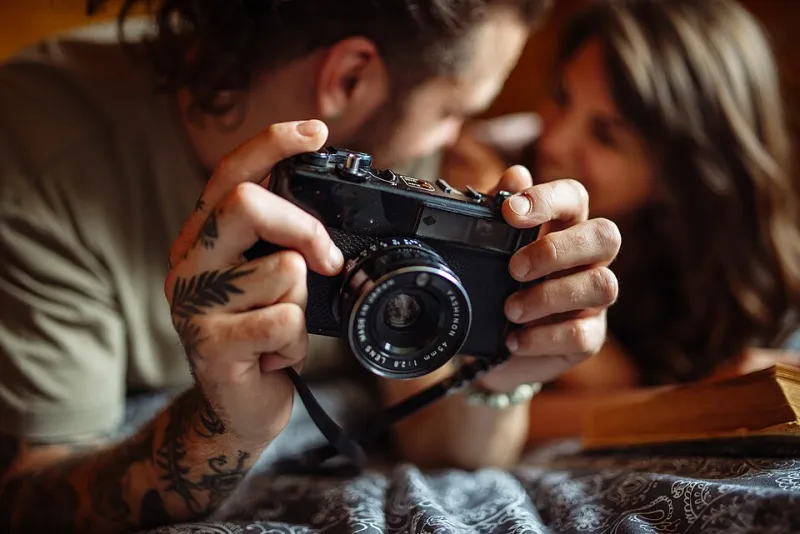
Photo: Shixart1985, CC BY 2.0, via Wikimedia Commons
Somewhere in Brooklyn, a 24-year-old is loading a roll of Kodak Portra 400 into a camera her grandmother used in 1987. In Austin, a college student is learning to develop black-and-white negatives in a darkroom he built in his bathroom. In Portland, a photographer with 90,000 Instagram followers is documenting her entire year on a single 35mm point-and-shoot.
None of this makes obvious sense in 2024. Film is expensive, slow, and unforgiving. You can't see your results immediately. You can't delete the bad ones. And yet, the analog photography movement isn't just alive — it's genuinely growing, driven largely by Gen Z and younger millennials who have no particular nostalgia for a pre-digital era they barely lived through.
So what's actually going on here?
The Paradox of Infinite Options
Talk to almost any photographer who's made the shift to film — or added it to their practice — and they'll eventually say some version of the same thing: digital gave me too much freedom, and it was making my work worse.
That sounds counterintuitive until you think about it for a second. When you're shooting digitally, the cost of a frame is essentially zero. You can fire 500 shots in an afternoon and sort through them later. The result, for a lot of photographers, is a kind of creative paralysis — a shoot-and-cull mentality that replaces decisive seeing with brute-force volume.
Film flips that dynamic completely. A standard 35mm roll gives you 36 exposures. Medium format might give you 12. Each frame costs real money — typically anywhere from 50 cents to over a dollar once you factor in film and development costs. That financial and physical constraint does something interesting to your brain: it forces you to slow down, look harder, and actually commit to a moment before you press the shutter.
Photographers describe it as a kind of enforced mindfulness. You can't spray and pray. You have to see.
The Tactile Thing Is Real
Beyond the creative discipline angle, there's something harder to quantify but just as real: film photography is physical in a way that digital simply isn't.
You load the camera with your hands. You advance the film manually. You feel the resistance of a mechanical shutter. When the roll is done, you rewind it, pop it out, and hold a little canister containing 36 moments you can't see yet. Then you wait — sometimes days — for the developed negatives or prints to come back.
For a generation that has grown up with instant everything, that waiting period turns out to be genuinely meaningful. There's anticipation involved. There's surprise. Sometimes there's disappointment, and sometimes a frame you barely remember taking turns out to be the best thing you've shot in months.
Darkroom operators across the US — many of whom nearly closed shop in the early 2010s when digital hit critical mass — report that their customer bases have not only recovered but skewed dramatically younger. Film labs in cities like Chicago, Los Angeles, and Nashville are booking out weeks in advance. Community darkrooms, where people can rent time to develop their own negatives and make prints, have opened or expanded in dozens of cities.
Social Media as an Unlikely Ally
Here's the twist that nobody predicted: Instagram, a platform built entirely around instant digital sharing, has become one of the primary engines of the film photography revival.
A whole ecosystem of creators has built substantial followings by documenting their analog journeys — sharing the process of loading cameras, showing developed negatives, posting scanned film photos with their characteristic grain and color rendering. Hashtags like #FilmPhotography and #ShootFilm have hundreds of millions of posts combined.
What resonates with audiences, creators in this space say, isn't just the aesthetic — though the look of film, with its organic grain, subtle color shifts, and tonal qualities, has proven incredibly durable in a sea of digitally processed images. It's the story of the process. The intentionality made visible.
There's also an authenticity signal at play. In an environment where AI-generated images are increasingly indistinguishable from photographs, a film photo carries an implicit proof of presence. Something real happened, in a real place, and a physical roll of film was there to catch it. For audiences increasingly skeptical of digital manipulation, that matters.
What Film Demands (and What It Gives Back)
It would be dishonest to romanticize this without acknowledging the friction involved. Film photography has a real learning curve, real ongoing costs, and real limitations that can be genuinely frustrating.
Exposure latitude — the range of light a film can handle — is narrower than most modern digital sensors. Shooting in challenging light without metering carefully will cost you frames. Color negative film handles certain lighting conditions beautifully and struggles with others. Black-and-white film requires understanding development chemistry if you're doing it yourself. None of this is impossible, but it's not casual either.
What photographers consistently say they get back in exchange is a different relationship with their own work. Because the stakes per frame are higher, the images that come out feel more earned. There's ownership in the process that's harder to achieve when you're culling through 400 RAW files on a laptop.
Several photographers working in this space describe a measurable improvement in their digital work after spending time with film — not because they abandoned digital, but because the habits of deliberate seeing they built with analog translated directly back to how they approached their digital shooting.
A Movement That Says Something Bigger
The film revival isn't really about nostalgia, even if it gets framed that way. Most of the young photographers driving it weren't alive for film's heyday. They're not trying to recreate the past.
What they're doing is making a deliberate choice about how they want to engage with their creative practice — and in doing so, pushing back against a broader cultural assumption that newer is always better, that more options always produce better outcomes, and that efficiency is the highest value in any creative process.
For a visual culture that sometimes feels overwhelmed by its own volume — billions of images uploaded daily, content cycles measured in hours — there's something genuinely radical about slowing down to 36 frames and waiting three days to see them.
The grain isn't an imperfection. For a lot of photographers right now, it's the whole point.