When the Feed Became the Boss: Photographers Who Burned Their Viral Formulas to Find Themselves Again
The Moment You Realize the App Is Driving
It usually doesn't announce itself. There's no dramatic turning point, no single morning where you wake up and think, I've let a recommendation engine redesign my entire artistic identity. Instead, it happens in small, almost invisible increments — a slightly warmer filter here, a compositional shortcut there, a subject choice made not because it excited you but because something similar got 800 likes three weeks ago.
For Portland-based photographer Dana Merritt, the realization came while scrolling her own grid. "I genuinely couldn't tell my work apart from five other accounts I followed," she says. "Same golden-hour tones, same negative space, same moody-but-accessible vibe. And the worst part? My engagement was through the roof. The algorithm loved it. I hated it."
Dana's experience isn't unique. Across the country, photographers, illustrators, and visual artists are waking up to the same uncomfortable truth: sustained social media success can quietly function as a creative straitjacket. The more you're rewarded for a specific aesthetic, the harder it becomes to deviate from it — and the more deviation starts to feel like professional risk rather than artistic growth.
How the Algorithm Trains You Without Asking
Here's the mechanic that makes this so insidious. Platforms like Instagram don't tell you to change your art. They just show you, through the cold language of metrics, which version of your art they prefer. Over time, most creators — consciously or not — begin to optimize.
Social media researcher and visual culture writer Marcus Obi describes it as "aesthetic Pavlov." The platform rewards certain outputs with reach and engagement, and the human brain, wired to seek positive reinforcement, begins producing more of those outputs. "You're not selling out in any dramatic sense," he explains. "You're just slowly, repeatedly choosing the path that feels safer. And after a year of that, you look up and you're somewhere you never intended to go."
For many photographers, the homogenization shows up in predictable ways: a gravitational pull toward soft, desaturated palettes; a preference for uncluttered, easily-digestible compositions; a tendency to shoot subjects that photograph well on small screens rather than subjects that matter to them personally. Street photography gets abandoned for lifestyle content. Experimental darkroom work gets shelved in favor of clean, bright flatlays. The feed wins.
The Cost of Keeping the Numbers Up
Chicago-based commercial photographer Ray Esposito spent two years building what he calls "a very pretty, very empty" Instagram presence. His account hit 40,000 followers by leaning hard into architectural minimalism — a style he was technically skilled at but creatively indifferent to. The work paid well. It also made him miserable.
"I'd started photography because I was obsessed with people," Ray says. "Faces, movement, the chaos of the street. But that stuff doesn't perform. So I just... stopped making it. I told myself I'd get back to it eventually. Eventually kept not coming."
The financial dimension makes this harder to dismiss as mere vanity. For working artists who depend on brand partnerships, print sales, or client referrals driven by social visibility, follower counts aren't abstract vanity metrics — they're part of a real economic ecosystem. Deliberately breaking a successful formula carries genuine financial stakes, which is why so many creators feel trapped even after they've identified the problem.
"I knew what I was doing," says Brooklyn illustrator Simone Varga, who spent eighteen months producing highly shareable, brightly colored digital portraits before she finally stopped. "I knew the work wasn't representing me. But I also had rent. And the algorithm had basically become my employer."
Burning the Formula Down
So what does it actually look like when artists decide to take their creative voice back? It turns out it looks a lot like loss — at least at first.
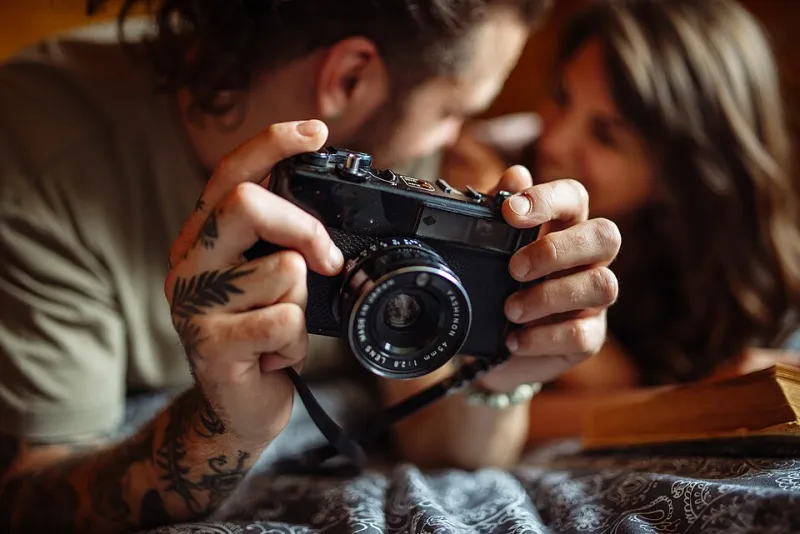
Dana Merritt started by posting a single image that broke every pattern her feed had established: a grainy, high-contrast black-and-white shot taken with a battered film camera, no warm tones, no clean composition, no obvious accessibility. "It got maybe a quarter of my usual engagement," she says with a laugh. "And it was the first time in over a year that I felt genuinely proud of something I'd posted."
For Ray Esposito, the return to people-focused street photography was gradual and uncomfortable. He lost brand deals. His follower growth stalled. He also, for the first time in years, started looking forward to going out with his camera. "The numbers went down. The joy went up. That's not a small trade."
Simone Varga took a different approach — she announced the shift directly to her audience, explaining that her work was evolving and that some of them might not come along for the ride. About 2,000 followers unfollowed her in the weeks after. Several hundred new ones, people who responded specifically to the rawer, more personal work she was making, showed up to replace them. "The followers I lost weren't really my people," she reflects. "They were the algorithm's people."
What Reclaiming Your Art Actually Requires
The photographers and artists who've successfully navigated this terrain tend to share a few common threads. First, they stopped using engagement metrics as a measure of creative quality — a harder habit to break than it sounds. Second, they gave themselves permission to make work that wasn't designed for the feed, even if it never got posted. Third, they reconnected with whatever originally made them pick up a camera or a pen or a stylus in the first place.
Marcus Obi puts it plainly: "The algorithm is very good at telling you what's popular. It is completely useless at telling you what's meaningful. Those are different questions, and artists have to decide which one they're actually trying to answer."
There's also something worth naming about the courage this requires. We live in a cultural moment that treats follower counts as a proxy for legitimacy. Choosing to make work that shrinks your audience — even temporarily, even intentionally — cuts against every signal the attention economy sends. It's a quiet, personal act of rebellion, and it rarely makes for a compelling Instagram story.
But here at Pictures Etc., we'd argue that's exactly the point. The most interesting visual work has never been the most optimized work. The images that stay with us, the photographs that end up meaning something, almost never arrived because a creator was chasing reach. They arrived because someone made exactly what they needed to make, algorithm be damned.
Dana Merritt's grid still doesn't perform the way it used to. She's fine with that. "I look at my feed now and it actually looks like me," she says. "That's worth more than the numbers. At least it is to me."